
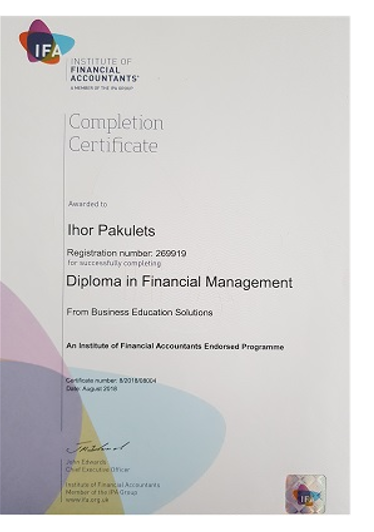
InBridge employees Consulting confirmed their competence by obtaining IFA ( institute of financial accountings - London, United Kingdom) Certificate in Financial Management (Certificate Number: 269919; Certificate Number: 8/2018/08004)
 Confirmation of competence was conducted in the following areas:
Fundamentals of the Company's financial management.
Essence, purpose and content of financial management of the Company. Principles and functions of financial management. Terms of operation of financial management in the Company. Strategy and tactics: methods and techniques of financial management.
Financial, legal and tax environment and business support.
The business environment is the law and taxation system. Impact of changes in the environment on the possibility of implementing a business development strategy. Tax planning of the Company as a method financial management. Financial environment and financial support of business: financial markets (money market, capital market, financial instruments markets), financial institutes (investment companies, financial intermediaries, organizations that provide financial services, banking services), interest and interest rates.
Financial and managerial accounting and reporting as an information base for financial management.
General characteristics, purpose, objectives, principles and purpose of financial and managerial accounting of the Company. Financial reporting - reflection financial status, results activity and cash flow of the Company. Presentation of financial statements as a means of raising capital. Management and special internal reporting of the Company.
Financial analysis, diagnostics and forecasting of the financial condition of the Company.
Analysis as a function of financial management. Purpose, tasks and methods of financial analysis and diagnostics of the financial position of the Company. Using the results of analysis for purposes development strategies and tactics of effective financial management of the Company.
Fundamentals of Financial Mathematics.
Logic of financial transactions. The concept of the value of money in time. Factors affecting the change in the value of money. Simple and complex interest. Future and real value of money. Accounting for inflation when assessing the value of money in time. Cash flows - build up and discount. Annuities. Analysis of alternative opportunities for investing money in simple examples.
Managing business profitability.
The essence of the concepts of "income", "expenses", "profit / loss". Types and costing (permanent / variable, direct / indirect, conditional, permanent and mixed). Methods of distributing mixed costs on constants and variables.Methods of distribution of constant expenses by types of products (ABC - analysis). Breakdown Business Analysis and Forecasting (CVP Analysis). Marginal income, margin of financial strength, operating lever.
Working capital management.
Fundamentals of the Company's Working Capital Management. The essence of working capital. Current assets: types and classification, basic management methods. The operating cycle of the Company (purchase, production, storage, sale). Short-term and long-term financing of working capital. Calculation of labor requirements. Management of cash and cash equivalents. Cash as the most liquid asset. Equivalents of cash. Storage and management of cash balances.Fundraising. Foreign currency lending to buyers. New business technologies: e-commerce, plastic cards, virtual markets and money. Turnover of funds. Debt management. Building an effective and acceptable sales policy for the company. Methods of collecting receivables. Stimulating buyers to repay debts. Flexible contracts. Analysis of clients' creditworthiness and reserves of unpaid bills. Turnover of accounts receivable. Inventory management. Types and forms of inventory existence. Analysis of risks, costs and benefits associated with the use of stocks. Control of stocks at different stages: procurement, processing, storage, transfer for sale. Calculation of optimal needs of the Company in stocks. Calculation of the optimal volume and frequency of orders. Stock turnover.
Valuation of cash flows.
Cash flows: types and characteristics. Management of cash flows from different types of activities. Drawing up of a statement of cash flows. Development of policies and programs for optimizing cash flows of the enterprise. Drawing up of revenue and spending schedules.
Financing current assets.
Credit and investment policy of the Company. Accounts payable, formation of relations with creditors. Trade payables. Use of bills in the calculations. Different Terms of Credit Sales. Short-term loans, letters of credit, bank acceptances, credit line (overdraft). Financial cycle.
Financial Asset Management.
Methods of estimating the value of financial assets (balance sheet, market, internal). Estimation of the value of various types of bonds (perpetual and urgent). Features of evaluation of urgent bonds (coupon and bezukuponnyh ).Estimation of profitability of bonds to repayment and to repurchase. Estimation of the value of simple and preferred shares.
Portfolio Analysis and Financial Risk Management.
The process of forming a portfolio of financial investments. The quality of financial instruments. Estimation of certain financial instruments of investment. Methods of managing a portfolio of financial investments. Financial risk management methods. Derivative financial instruments.
Estimation of cost of capital and optimization of its structure.
Capital. Components of capital (own and borrowed). Methods and models for assessing the value of individual types of capital: the cost of debt and equity, preferred shares. The weighted average cost of capital is the use of results and decision-making. Financial leverage. Optimization of the structure of capital depending on the influence of various factors on its cost. Managing own and borrowed capital. Emission and dividend policy. Preparation of loan repayment schedules.
Criteria for assessing the effectiveness of mid-term and long-term investment projects.
Investment project, concept, types. Technology of planning investment projects. Estimation and selection of investment projects. Methods of analysis of investment projects (net present value, profitability, payback period, internal rate of return) and decision making on investment. Control over implementation of the plan for the implementation of investment projects.
Analysis and risk management of investment projects.
Analysis of the sensitivity of the investment project. Evaluation of projects with uneven implementation dates.